Irish Tattoo Ideas
I compare the Harp, Shamrock, Claddagh, Ogham and knotwork, explain how much space each needs and show a Trinity Knot tattoo from my portfolio.
Written by MillyTattoo Artist & Studio OwnerMilly Tattoo, Birr, Co. Offaly15+ Years1500+ Tattoos
How I turn an Irish reference into a tattoo
Table of Contents
What connects you to the Irish subject you want to wear: a person, a place, a language, music, faith or an object whose shape you love? That is a useful starting point for choosing the design.
I work from my studio in Birr. For most Irish references, I can check the visual or historical source. I simplify details that are too small for the chosen size and draw the piece for the body. Ogham follows a separate process. Bring the final inscription after an independent language and symbol check; I work only with its placement on the body.
Irish and Celtic describe different things
"Irish" can be very specific: the state Harp, a Shamrock, a Claddagh ring, an Ogham inscription, a county outline, or decoration from an Irish manuscript. "Celtic" covers a much wider history and geography. Modern tattoo references often mix Irish manuscript interlace, later revival designs and contemporary patterns under the same heading.
That mix is not automatically a problem. It becomes a problem when a modern design is sold as an exact ancient symbol with an exact ancient definition. If historical accuracy matters to you, bring the original source rather than a screenshot that has been reposted without context.
The Trinity College manuscript-art project describes repetition, spirals and crossings in knotwork as key parts of Insular art. That gives me a real visual starting point. It doesn't give every knot on Pinterest a fixed dictionary meaning.
Seven practical ways to narrow the idea
Compare the subject with the detail it needs.
Shamrock
Is your connection Ireland, St Patrick's Day or simply the shape?
Keep three leaves clear and distinct from a four-leaf clover.
Harp
Is it about Ireland, music or a particular instrument?
Strings and negative spaces decide the minimum size.
Claddagh
Does it refer to love, friendship, Galway or a ring in your family?
Hands and crown need more room than the outline suggests.
Ogham
Is there a specific name or short Irish word you want to preserve?
Bring the final Ogham inscription and reading direction from that checked version.
Interlace or knotwork
Is the unbroken path, faith, family or simply the pattern itself important to you?
Keep every crossing and gap consistent and readable.
Celtic cross
Is faith, remembrance or cultural connection the starting point?
Choose a clear source and leave enough room for the cross to read well.
County, map or landscape
Is one town, county, coast or view more personal than a national symbol?
Simplify coastlines and small boundaries for skin.
St Brigid's Cross: choose the weave as well as the symbol
The National Museum of Ireland describes 1 February as St Brigid's Day and the beginning of spring in the traditional Irish calendar. It records several cross forms, including four-armed, diamond, interlaced and wheel-shaped designs, made with materials such as straw, rushes and reeds.
There is no need to turn all of that into one generic icon. If a cross from your home, family or area is the reason for the tattoo, send a clear photograph of that one. I can simplify the weave for the size while keeping the shape you actually recognise.
Shamrock: three leaves, not four
The Irish government lists the Shamrock and Harp as the official State emblems. Its state-emblems guidance describes the Shamrock as a green trefoil and records its use as a St Patrick's Day badge from the seventeenth century.
For a tattoo, the first decision is silhouette. At a small size I would keep the leaf edges clean and the stem simple. Veins, tiny Lettering and a knot wrapped around the stem all demand more space. If your reference has four leaves, it reads as a four-leaf clover and brings a different association. The Shamrock tattoo guide goes into the design choices in more detail.
Harp: recognisable, but not automatically simple
Ireland is the only nation with a musical instrument as its national emblem. The National Museum of Ireland traces the Harp's long public use and notes that it appears on coins, passports, seals and official documents.
That familiar outline works well in a tattoo, but the strings decide how small it can go. A Harp with eight narrow spaces between the strings needs a different plan from a solid silhouette. Tell me what matters most: a particular historical instrument, a family connection to music, or the state symbol. Each choice leads to a different drawing. See the Irish Harp tattoo guide for scale and placement examples.
Claddagh: keep the object recognisable
The Claddagh is not a medieval knot. The National Museum dates early examples of the ring style to around 1700. Galway City Museum holds a ring by Richard Joyce from about that time and describes it as a love token: two hands clasping a crowned heart. The familiar reading is friendship, love and loyalty.
On skin, the hands are normally the weak point. Reduce them too far and they turn into two vague shapes beside a heart. The crown also needs open gaps. The simple outer silhouette can stay modest in size; a ring-like drawing with fingers, cuffs and crown detail needs more room. The dedicated Claddagh tattoo guide explains what I simplify first.
Knotwork: judge the path, not the label
Good interlace should be easy to follow. The band passes over, then under, and the spacing stays deliberate around the whole design. I check the route of the line before I look at shading or decoration, because one broken crossing changes the structure.
The Book of Kells is an important reference, but its own history is more complicated than a souvenir label suggests. Trinity College dates it to around the year 800 and explains that its exact place of production is still debated. Its pages combine text with plant, animal, human and abstract ornament. I use historical material as visual research, not as permission to claim that a newly drawn knot has an ancient name and a guaranteed meaning.
Trinity Knot Ember Tattoo from my portfolio
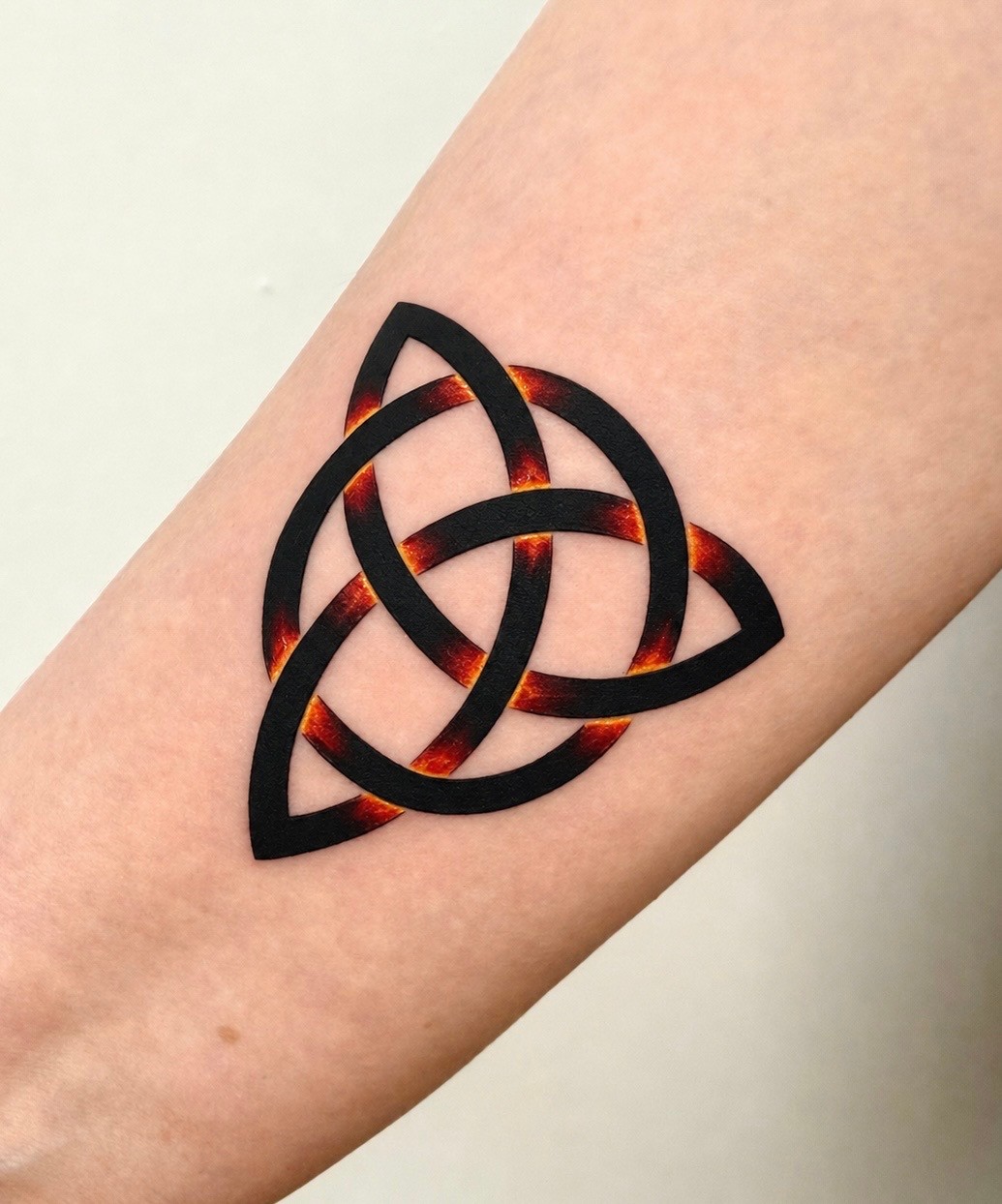
For Trinity Knot Ember Tattoo, I kept the bands and gaps even and drew the shape to the forearm. The ember colour sits at the crossings, so it helps the eye follow the route instead of hiding it. The black structure still needs to work without relying on colour.
If your main question is meaning rather than design, continue with the Celtic knot tattoo meaning guide. For a cross, use the separate Celtic cross tattoo guide.
Ogham: verify the word before styling it
Heritage Ireland describes Ogham as an ancient Irish alphabet and the earliest written source for the Irish language. On surviving stones, strokes sit on or around a stem line; inscriptions were usually vertical and read from bottom to top. Many recorded a person's name and were used as memorial or territorial markers.
For a tattoo, the order is important:
- Settle the exact name or short word.
- Complete an independent check of the Irish spelling, Ogham transcription, stroke direction, reading direction and meaning.
- Make sure the independent check includes orientation and the complete design at its intended size.
- Bring that finished version for placement and tattooing.
An anonymous converter screenshot is not enough. I place the checked version you supply; I don't validate it. The full Ogham tattoo guide explains what to prepare.
Irish words and names
The same caution applies to Irish-language Lettering. Grammar can change when a dictionary word becomes part of a phrase, and spelling is only one part of the job. Bring the wording in writing and tell me who verified it. I can design the Lettering and make it readable on skin, but the language needs independent verification.
If you want to use someone's handwriting, that is a different route again. Preserve the characteristic letters, remove accidental marks and choose a size that keeps the writing legible. You can see examples of this kind of work in my Lettering portfolio.
Place can be more personal than a national symbol
Your Irish tattoo doesn't need a Shamrock or knot. Sometimes a county outline, coastline, building detail, plant from a specific landscape, piece of family handwriting or object connected with home carries the connection more directly.
The useful reference is the one closest to the source: your own photograph, an archival image with a clear origin, an official map, or the actual object. I'll simplify it for the size and placement instead of tracing every detail. If you're considering the whole island or a county-based design, read the map of Ireland tattoo guide.
Compare the space each Irish symbol needs
Do not settle on the final size until you know which important gap is the smallest.
For Ogham, the spacing and length of the final supplied inscription decide the size.
Forearms and calves give long designs room to run. Upper arms and shoulder blades suit wider compositions. Wrists and strongly curved areas reduce the usable space and can force a simpler drawing. For custom-drawn motifs, I may need to simplify a layer of detail for a narrow or curved area.
Materials to send for a consultation
Send the idea through the booking form with:
- the connection to the person, place, word or object behind the idea;
- the body area and a clear photograph of that area;
- your approximate size;
- two or three useful references with their sources;
- the final Irish wording or Ogham form from the check described above;
- any part that must stay and, for custom-drawn motifs, any part you're happy for me to simplify.
For custom-drawn designs, I'll explain which details need more space or a simpler shape. Ogham uses the supplied-design process above. If you're still comparing symbols, use the tattoo meanings guide. See the tattoo pricing guide for current rates and the factors that affect a quote.
Sources used for the historical points
- Irish State emblems: Harp and Shamrock
- O'Carolan's Harp, National Museum of Ireland
- Claddagh Rings, National Museum of Ireland
- Claddagh ring by Richard Joyce, Galway City Museum
- Darrynane Beg Ogham Stone, Heritage Ireland
- Manuscript art research, Trinity College Dublin
- The Book of Kells, Trinity College Dublin Library
Irish connections and language checks
Choosing a subject from outside your own background, and preparing a checked inscription.
Can I choose an Irish tattoo if I was not born in Ireland?
Yes, but be clear about why you chose it and learn what the source actually is. Your visual connection, family link, faith, music or a place can all be honest reasons. I would not claim ancestry or a traditional meaning that is not yours.
Is an online Ogham converter enough for a tattoo?
No. Use a converter only as a starting point. Have the final Irish spelling, Ogham transcription, stroke form, orientation, reading direction and meaning checked independently. I tattoo the version you supply and handle its placement; I don't verify the language or symbols.
Discuss your Irish tattoo idea
Send your brief and I'll explain the next step. For Ogham, please supply the independently verified version described above.