
Butterfly tattoo meaning is not fixed by a universal symbol list. It can mark change, freedom, grief, recovery, family or a new stage of life, but its meaning comes from the person wearing it. Some people just love the shape of the wings. That's a complete reason on its own.
I start with your story, then work out the silhouette and how many butterflies belong in the design. From there, I decide how they move, where they sit and how large they need to be.
Meaning starts with your own connection
A person, a place or a difficult period that ended can give you a starting point for the drawing.
Change is a common personal reading because a butterfly develops through distinct life stages. Freedom and movement are also common associations. Memorial designs may use one butterfly for one person, while a family piece may use several forms. These are modern personal choices, not compulsory translations from an ancient code.
My tattoo meanings guide helps compare the meanings of other subjects.
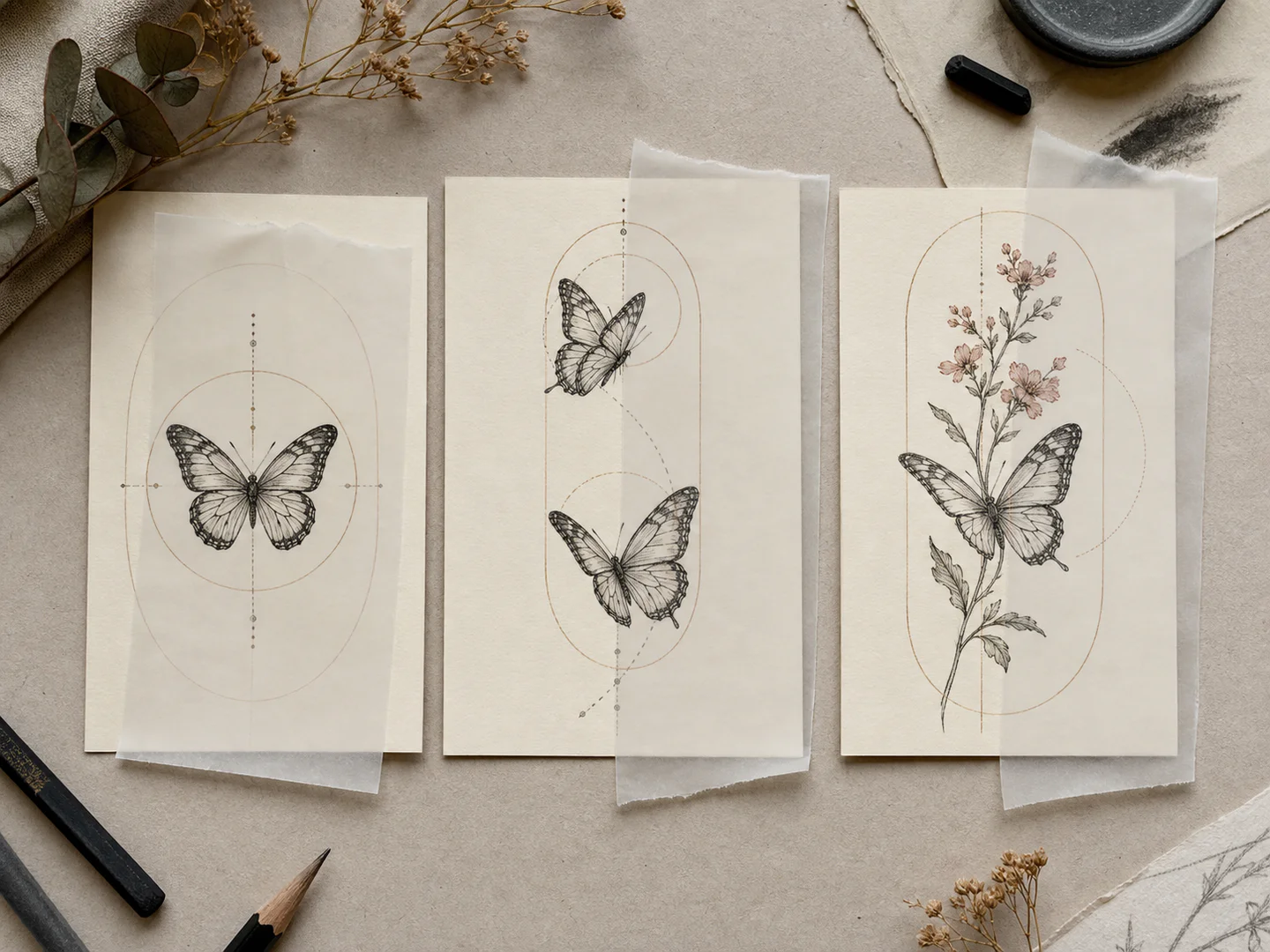
The AI-assisted illustration below compares a single butterfly, a pair and a butterfly-and-flower arrangement. It is a planning example, not a finished tattoo or a Flash design.
One butterfly, a pair or a moving group
One butterfly creates a clear focal point. The wings can carry more character because they do not have to compete with repeated shapes. One flower, a short date or a small piece of handwriting may fit beside it when the scale leaves enough open skin.
Two butterflies create a relationship through distance, direction and size. They can face each other, travel together or move apart. That can suit partners, siblings, a parent and child, two memories or two stages of the same life. Two butterflies don't have to mean romance. You decide who they are, and I build the composition around that.
Three or more butterflies need a route across the body. I vary their size, angle and spacing so they feel connected without looking like the same stamp repeated. Extra initials, flowers and dates quickly consume the open space that keeps the wings readable. When every butterfly must carry a separate detail, the tattoo normally needs a larger area or fewer competing details.
The small tattoo ideas guide explains why a compact design still needs clear gaps and a strong outer shape.
Butterfly and moth need different drawings
Butterflies and moths share a basic winged structure, yet their silhouettes are not interchangeable. Butterfly wings often support a lighter sense of flight and an uneven moving pose. Moths often suit a broader centre, stronger symmetry and a quieter or darker composition. Those are visual qualities, not emotional rules.
The skull, moth and rose tattoo in my portfolio shows how a real moth shape holds a dark central subject and wide wings. It is not an example of butterfly work. If the brief asks for a butterfly, I redraw the wing structure and movement instead of relabelling a moth.
Flowers can add a specific connection when they have a reason to be there. Birth flowers may represent a person or month. Plants from a family garden, wedding bouquet or memorial arrangement can be more personal than a generic rose. Petals, leaves and wings still need separate space, so I choose which element leads before adding detail.
Placement and scale shape the result
Open wings need enough width. Side-view designs need a silhouette that remains recognisable with fewer internal lines. Several butterflies need room to move, while a symmetrical piece needs a body area where the centre can be aligned and checked at stencil stage.
Forearm, upper arm and calf can carry a single butterfly or a travelling composition along the limb. Shoulder blade and upper back give open wings more width. Thigh and ribs can support a larger arrangement with flowers, although the body curve changes how much of it can be seen from one angle. Wrist and ankle suit a simpler outline when the chosen size is genuinely small.
Tiny wing veins may look precise on a bright screen but close up on skin over time. I protect negative space, simplify repeated lines and test the design at its real printed size. Placement is not selected from a label alone. I need a straight, well lit photograph of the body area and an approximate size in centimetres.
Colour changes the brief too. Strong colour needs room for clean separation. Black and grey can rely more on tone and line, but the wing pattern still has to remain legible. Neither route is automatically more delicate or more durable. The exact structure matters more than the category name.
Build a useful brief before the drawing starts
Useful references show wing shape, movement, line weight, colour or atmosphere. They do not need to be copied into one crowded design. Bring references of the insect and pose you want. Photographs of real butterfly species can be more helpful than another tattoo when a particular wing matters.
Send these decisions with the enquiry:
- who or what the butterfly connects to, if it has a personal meaning;
- one butterfly, a pair or a group;
- the exact body area and approximate size;
- colour or black and grey;
- details that must stay, such as a date, flower or handwriting;
- two or three focused references with a note about what you like in each one.
Send names, dates and handwriting in writing so nothing is missed over the phone. For a memorial piece, we check them together again before you approve the stencil. When several people are represented, one shared visual idea is usually clearer than a different symbol for every person.
The custom tattoo service explains how I turn references into a new design for the body. Use booking to send the placement, size and focused references. I can then say what will remain clear, what needs more room and what should be removed before drawing.


