
To plan a birth flower tattoo, I begin with the birth months and the flower each person connects with. Then I draw them as one bouquet, choosing a main bloom and leaving enough space between the petals and stems.
Month lists are only a starting point. Different traditions assign more than one flower to some months, and a family may already prefer another choice. The tattoo should preserve that connection instead of forcing every person into one online chart.
Birth flowers by month
This list gives practical starting points for a tattoo brief. Choose the flower you recognise or the one that suits the person. Shape, scale and the number of other flowers matter as much as the month label.
- January: carnation or snowdrop. Carnations need room for layered petals, while snowdrops create a quieter hanging shape.
- February: violet or iris. Violets sit well in a low cluster; an iris needs more width and a stronger outline.
- March: daffodil. Its trumpet centre helps the flower remain recognisable after the drawing is simplified.
- April: daisy or sweet pea. Daisies keep a clear round head; sweet pea gives the bouquet a softer climbing line.
- May: lily of the valley or hawthorn. Small bells need separation, while hawthorn can bring leaves and small blossom groups.
- June: rose or honeysuckle. Rose can lead the bouquet, while honeysuckle can travel between larger flowers.
- July: larkspur or water lily. Larkspur adds height, while a water lily suits a wider arrangement.
- August: gladiolus or poppy. Gladiolus creates a tall spine; poppy gives a broad head with a simpler silhouette.
- September: aster or morning glory. Asters add repeated small heads; morning glory needs width for its open shape.
- October: marigold or cosmos. Marigold brings dense texture; cosmos can keep a busy group lighter.
- November: chrysanthemum. Its layered head normally needs more size than a small daisy or simple poppy.
- December: holly or narcissus. Holly adds leaves and berries; narcissus keeps the composition focused on petals and stems.
Record why each flower was chosen so I know which features matter when simplifying the drawing. Personal history can overrule the list. Your grandmother's favourite flower, a plant from a family garden or something saved from a wedding bouquet may carry a clearer connection than the usual month association.
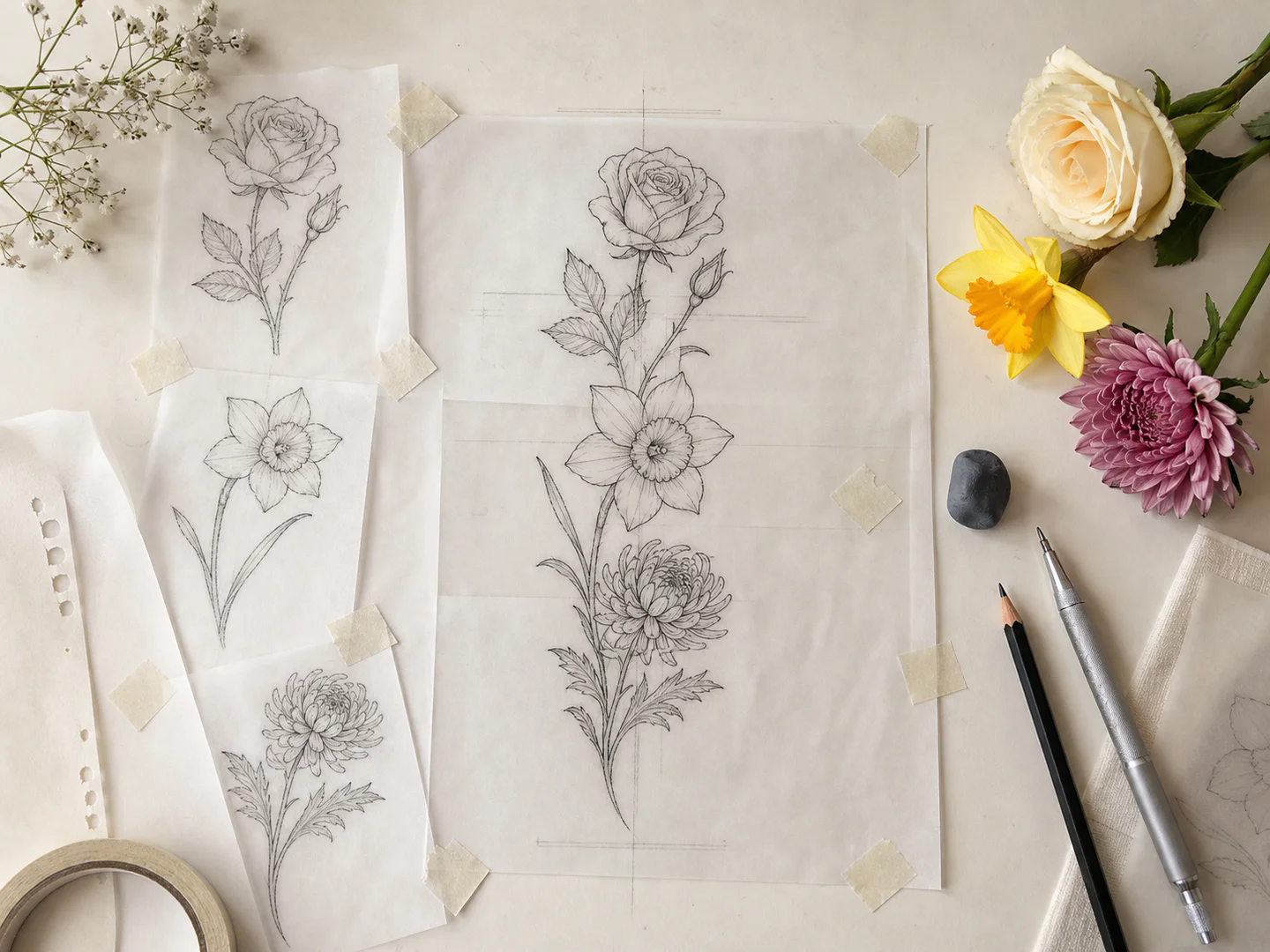
The AI-assisted illustration below shows one way to arrange a rose, daffodil and chrysanthemum as a family bouquet. It is a planning example, not a finished tattoo or a Flash design.
Turn several months into one bouquet
Family bouquets become clearer when one flower leads and the others support it. Giving every bloom the same size can make the design look like separate stickers tied together. I usually choose one main head, one or two supporting shapes and lighter stems that connect the group.
Repeated months do not require mechanical copies. Two June birthdays might use one open rose and one smaller bud. Three March dates could become daffodils at different angles. Separate stems may meet near the base for siblings, while a parent and child idea might use a branch that divides naturally.
The family tattoo article covers broader ways to represent relatives without assigning everybody a separate symbol. Month flowers remain a narrower route for building one botanical composition.
Use the Floral portfolio to judge line weight, scale and finish on skin.
Match placement to the shape
Stem direction often decides placement before the individual flower does. Long arrangements can follow a forearm, upper arm, calf, thigh, ribs or spine. Rounder groups can sit on a shoulder blade, upper arm or outer thigh. The drawing should follow the body. I won't shrink it just to fit a size label.
One flower can work at a modest size if its silhouette is simple. Two or three stems need room to overlap without turning into parallel lines. Four or more flowers normally need more centimetres, not thinner outlines. The busiest flower sets the minimum size for the whole bouquet. Lettering also needs a clear gap away from petals and leaves.
The placement portfolio helps compare real work by body area. Send a straight, well-lit photograph of the intended area and an approximate size in centimetres. I can then test the bouquet at its real printed scale instead of judging it from a cropped reference image.
Add dates, initials or handwriting carefully
Names, initials and dates are optional. The flowers can carry the family connection without spelling it out for everyone else.
When lettering is included, I keep it far enough from the stems to remain readable. One date may sit below tied stems, follow a quiet curve or occupy an open gap. Several names threaded through several flowers usually compete with the petals. Initials or one short piece of genuine handwriting may be cleaner.
Extra symbols need the same restraint. Ribbon, butterflies, birthstones, stars and a long quote cannot all lead one small design. The small tattoo guide explains why a clear outline and open spacing matter more as the available area becomes smaller.
Leave a natural route for future additions
Future flowers can often be added when the first drawing includes a deliberate direction for another stem. Tell me about possible additions before the original design is drawn. Leaving an open edge or spare branch point is more useful than keeping an empty hole in the centre.
The first tattoo should still feel complete. I don't leave a random blank area that makes the bouquet look unfinished for years. Forearm, upper arm and thigh placements normally offer more usable expansion space than a tight wrist cluster, but the exact opportunity depends on the first composition.
Build a useful custom brief
You don't need to assemble the final bouquet yourself. Send the facts and the visual preferences that matter:
- each person's birth month and their relationship to you;
- the chosen flower when a month has alternatives;
- any flower you definitely do not want;
- the body area and approximate size in centimetres;
- black and grey or colour;
- names, dates or handwriting that must be checked;
- two or three references with a note about what you like in each one;
- whether another family member may be added later.
References should explain mood, stem movement, petal shape or line weight, not supply another artist's tattoo to copy. The custom tattoo service explains how I turn that information into a new drawing for the body. When the list is ready, send it through booking so I can check whether the number of flowers fits the intended size.


